


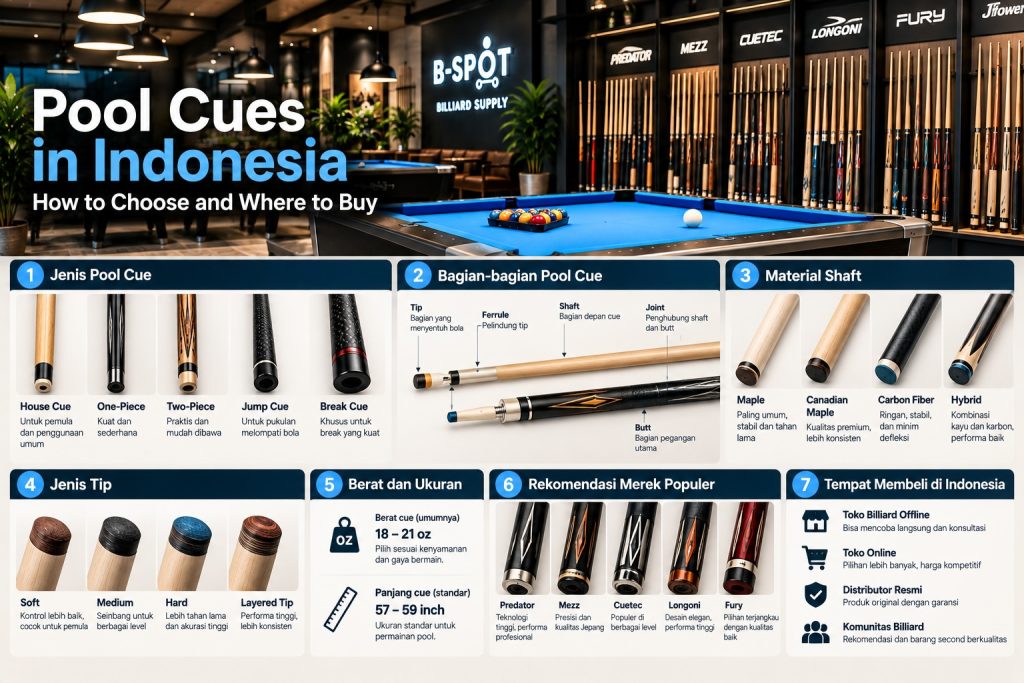
A good pool cue is the one piece of billiard equipment most players eventually want to own. House cues at venues are often worn, warped or fitted with flattened tips, so a personal cue gives you consistency from one session to the next.
This guide explains what to look for in weight, tip and shaft, compares carbon fibre and maple shafts, outlines typical price tiers, and shows how to find trustworthy sellers in Indonesia, whether you shop in Jakarta, Bali or online.
Cue Weight, Tip and Shaft: The Basics
Three things shape how a cue feels when you strike the ball: its weight, the tip and the shaft. Getting these right matters more than the brand name or the design on the butt.
Weight
Most playing cues weigh roughly 18 to 21 oz (about 510 to 595 g), with 19 oz a popular middle ground. A heavier cue can feel more stable and helps on the break, while a lighter cue can feel quicker and gives some players more touch and spin control. If possible, try a few weights before buying. Many cues have adjustable weight bolts in the butt, which lets you fine-tune later.
Length
The standard length is about 57 to 58 in (around 145 to 147 cm). Taller players or those with a long reach sometimes prefer a slightly longer cue or an extension. Shorter cues are useful for children or for tight spaces near walls.
Tip
The tip is where the cue meets the ball, so it has a large effect on control:
- Diameter. Pool cue tips are commonly between about 11.75 and 13 mm. A larger tip feels more forgiving, while a smaller tip can make it easier to apply spin precisely.
- Hardness. Soft tips grip the ball well and help with spin but wear faster. Hard tips last longer and give a crisper hit. Medium tips are a sensible starting point.
- Construction. Layered leather tips are popular for consistency. Solid leather tips are simpler and usually cheaper.
Shaft and taper
The shaft is the front section of a two-piece cue. Its taper describes how the diameter changes from tip to joint. A “pro taper” stays slim for longer, which many players find smooth for a long stroke. Shafts also differ in deflection, which is how far the cue ball pushes off line when you use side spin. Low-deflection shafts reduce this effect and can make aiming with spin easier.
Joint
The joint connects the shaft and butt. Common styles include steel joints, which give a firmer feel, and wood-to-wood or other non-metal joints, which some players describe as softer. Neither is right or wrong; it comes down to preference.
Carbon vs Maple Shafts
The biggest decision for many buyers today is whether to choose a traditional maple shaft or a carbon fibre shaft.
Maple shafts
Maple has been the traditional shaft wood for generations. It gives a natural feel and feedback that many players love. However, wood reacts to humidity and temperature, so a maple shaft can warp if stored badly. In Indonesia’s humid climate, careful storage in a case and away from heat is important.
Carbon fibre shafts
Carbon fibre shafts are designed to resist warping and to stay consistent over time. Many are built as low-deflection shafts and are easy to wipe clean. They are generally more expensive than standard maple shafts, and some players find the feel stiffer or less natural at first.
Side-by-side comparison
| Aspect | Maple | Carbon fibre |
|---|---|---|
| Feel | Natural, traditional | Often stiffer, very consistent |
| Warping risk | Higher in humid conditions | Low |
| Deflection | Standard, low-deflection options exist | Usually low deflection |
| Maintenance | Needs cleaning and careful storage | Easy to wipe clean |
| Relative price | Low to medium | Medium to high |
For a beginner, a solid maple cue is a practical first choice. If you already play regularly and want consistency in a humid environment, carbon fibre is worth considering.
Pool Cue Price Tiers
A pool cue price varies widely, and prices change quickly with exchange rates and stock. Rather than quote figures, it is more useful to understand the tiers and what you get in each.
| Tier | Typical characteristics | Relative price |
|---|---|---|
| Entry level | One-piece or basic two-piece, simple maple shaft, basic tip | Low |
| Mid range | Two-piece, better maple or entry carbon shaft, layered tip, quality joint | Medium |
| Premium | Branded low-deflection or carbon shaft, high-end tip, fine butt work, inlays | High |
What drives the price
- Shaft technology, especially low-deflection and carbon fibre shafts
- Tip quality, with layered premium tips costing more
- Butt materials and craftsmanship, including inlays and wraps
- Brand and import costs, since many cues sold in Indonesia are imported
- Accessories, such as a hard case, extension or spare shaft
A cheap pool cue can still be a good choice for learning, as long as it is straight and has a decent tip. When people search for the best pool cue, the honest answer is the one that suits your stroke, budget and playing frequency.
Where to Buy: Finding Trusted Stores
The pool cue indonesia market includes both local and imported cues. Sellers usually fall into a few groups:
- Billiard specialty shops, where you can hold and test cues before buying
- Billiard venues that sell cues and accessories to their regular players
- Online marketplaces, which offer wide choice and easy price comparison
- Used-cue sellers and player communities, often active on social media
How to vet a seller
Whichever channel you use, check a few things before you pay:
- Look for detailed photos of the tip, joint and full length of the cue
- Read recent reviews and check how long the seller has been active
- Ask whether the product is original and request proof for branded cues
- Confirm the return policy if the cue arrives bent or damaged
- Be cautious of branded cues priced far below the usual market level
Jakarta
Shoppers looking for a pool cue jakarta option will find the widest choice of specialty shops and venues in Greater Jakarta. Visiting in person lets you roll the cue on a flat surface to check straightness and try different weights.
Bali
For a pool cue bali purchase, the local selection may be smaller, so many players order online from sellers in Java. Ask the seller to pack the cue in a tube or hard case to prevent damage in transit.
Buying Tips Before You Pay
Before you buy pool cue equipment, run through this short checklist:
- Check straightness. Roll the assembled cue on a flat table and watch for wobble.
- Inspect the tip and ferrule. They should be firmly attached with no cracks.
- Test the joint. It should screw together smoothly and sit tight.
- Hold it in your stance. Weight and balance should feel natural.
- Budget for a case. A case protects your investment from knocks and humidity.
If you browse a pool cue for sale listing online, ask for a video of the cue being rolled on a table. It is a simple way to spot a warped shaft.
Caring for Your Cue
A well-maintained cue lasts for years. Wipe the shaft after each session to remove chalk and hand oils, and store the cue in a case rather than leaning it against a wall. Keep it away from car boots, windows and air-conditioning vents, where temperature and humidity change sharply. Shape and scuff the tip occasionally so it holds chalk, and replace it once it becomes flat or hard.
FAQ About Pool Cues
What weight should a beginner choose? A cue of around 19 oz is a balanced starting point for most players. Try lighter and heavier options if you can.
Is a carbon fibre shaft worth it? It can be, especially in humid climates or for players who want consistency and low deflection. Beginners can start with maple.
How often should I replace the tip? It depends on how often you play and how hard the tip is. Replace it when it becomes flat, hard or no longer holds chalk.
Can I use a pool cue for snooker? You can, but snooker cues usually have smaller tips to suit the smaller snooker balls, so a dedicated snooker cue is better for regular play.
Contact B-Spot / Step Asia
B-Spot and Step Asia work with venues, offices and businesses that need billiard tables and equipment.
- Table placement in cafes and venues through the B-Spot partner programme
- Table rental for offices, residences and events
- Supply inquiries for tables, cues and accessories
Contact B-Spot / Step Asia for placement, rental or supply inquiries. Reach us through bspot.app.