


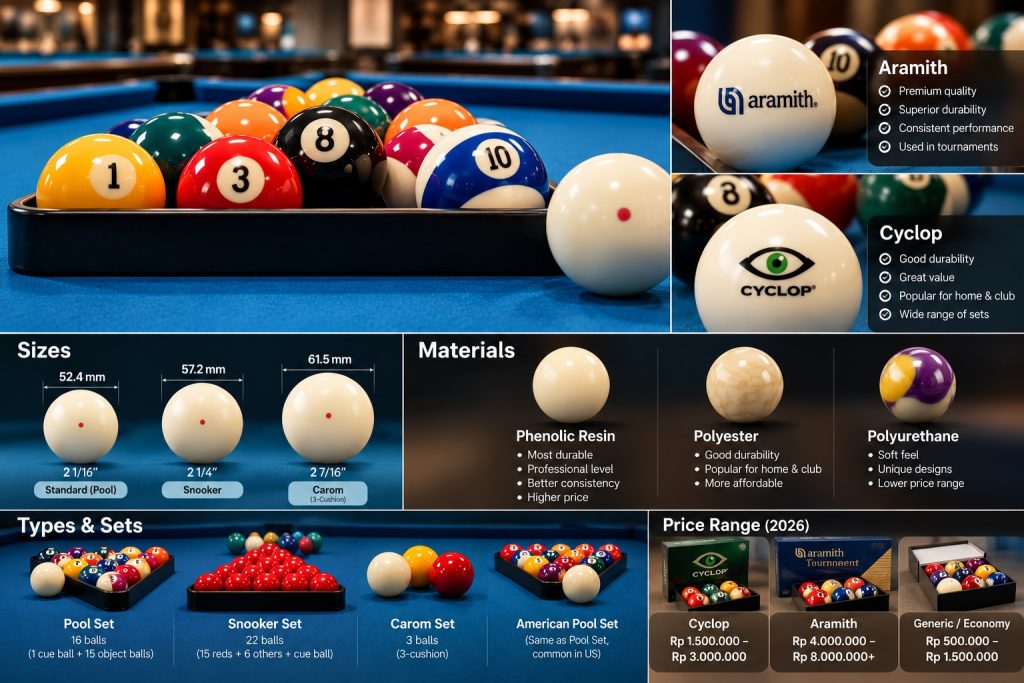
Buying billiard balls sounds easy until you notice how many sizes, materials and set types there are. The right set depends on the game you play, the table you own and how often the balls will be used, whether at home, in an office or in a busy venue.
This guide covers standard ball sizes, the difference between phenolic resin and polyester, the main set types, how to care for your balls, and what affects price. It also includes practical tips for buyers in Indonesia, including Jakarta and Bali.
Standard Billiard Ball Sizes
Ball size is not the same across all cue sports. Using the wrong size makes the game feel off and can affect how balls fit the pockets.
American pool (8-ball and 9-ball)
The most common type in Indonesia is the American pool set. Under WPA specifications, each ball measures 2¼ in (57.15 mm) and weighs between 156 and 170 g. A standard set has 16 balls: 15 numbered object balls plus a white cue ball.
Snooker
Snooker balls are smaller, at 52.5 mm in diameter. A full snooker set has 22 balls: 15 reds, six colours and a white cue ball. Snooker tables have tight pockets designed for this smaller size.
English pool (blackball)
English pool, common in the UK, uses smaller balls than American pool. Object balls are most commonly 2 in (about 51 mm). Sets usually include red and yellow groups plus a black ball, rather than numbered solids and stripes.
Carom
Carom billiards, played on tables without pockets, uses the largest balls, about 61–61.5 mm in diameter. A carom set usually has only three balls.
Size comparison
| Game | Ball diameter | Balls per set |
|---|---|---|
| American pool | 57.15 mm (2¼ in) | 16 |
| Snooker | 52.5 mm | 22 |
| English pool | about 51 mm (2 in) | 16 |
| Carom | about 61–61.5 mm | 3 |
Always match the ball size to your table and the game you play. If you are unsure, check the pocket openings and the table’s specifications before you order.
Phenolic vs Polyester Balls
Material has the biggest effect on how long a set lasts and how it plays.
Phenolic resin
Phenolic resin is the material used in many premium and tournament sets, including well-known Belgian-made sets. It is generally harder and more resistant to scratches, chipping and heat from friction. Phenolic balls tend to keep their shine and roundness longer, which makes them a common choice for venues and serious players.
Polyester
Polyester balls are widely used in entry-level and recreational sets. They are typically cheaper to produce and perfectly usable for casual play. However, they usually show wear sooner, may lose their gloss faster and can develop small chips under heavy use, such as hard breaks every day in a busy venue.
Comparison table
| Aspect | Phenolic resin | Polyester |
|---|---|---|
| Hardness and durability | High | Moderate |
| Scratch and chip resistance | Better | Lower |
| Shine over time | Lasts longer | Fades sooner |
| Typical use | Tournaments, venues, serious home players | Casual home use, beginners |
| Relative price | Medium to high | Low |
For a home table that sees occasional play, polyester can be good value. For a cafe or venue where tables run for many hours a day, phenolic is usually the more economical choice over time because the set needs replacing less often.
Set Types
Beyond size and material, sets differ in design and purpose.
Standard numbered sets
The classic set has solids (1–7), stripes (9–15), the black 8 ball and a cue ball. This is the set most players in Indonesia expect to see on a pool table.
Tournament and TV sets
Some sets use special colours or patterns designed to show clearly on camera and for spectators. These are usually higher-end phenolic sets.
Training sets and training cue balls
Training cue balls have dots or markings that show how the ball spins after impact. They are useful for practising draw, follow and side spin.
Snooker, English pool and carom sets
These are separate sets made for those games and their sizes. They are not interchangeable with American pool sets.
Magnetic or oversized cue balls
Some coin-operated tables use special cue balls so the machine can separate them from object balls. If you own one of these tables, check which cue ball it needs before you buy.
How to Care for Your Balls
Good care keeps balls rolling true and looking good for longer:
- Clean regularly. Wipe balls with a soft microfibre cloth to remove chalk and dirt. Chalk on balls also transfers to the cloth.
- Use a proper ball cleaner. Avoid household chemicals and abrasive products, which can damage the surface.
- Polish occasionally. A dedicated ball polish restores shine and reduces friction.
- Store safely. Keep the set in its box or a ball tray, away from direct sunlight and heat.
- Rotate the cue ball. In venues, the cue ball wears fastest, so consider keeping a spare.
Clean balls also help protect your table cloth, because dirty balls drag chalk and grit across the surface.
Billiard Balls Price: What Affects It
The billiard balls price you see depends on several factors. Prices change with stock, exchange rates and promotions, so it is more useful to understand the tiers than to rely on a single figure.
| Tier | Typical characteristics | Relative price |
|---|---|---|
| Entry level | Polyester, standard colours, basic box | Low |
| Mid range | Phenolic or better polyester, consistent sizing | Medium |
| Premium | Branded phenolic tournament or TV set | High |
Price factors
- Material, with phenolic sets costing more than polyester
- Brand and origin, including import costs for brands made overseas
- Precision, meaning how closely balls match in size and weight
- Set type, with tournament and training sets often priced higher
- Packaging and accessories, such as a case or cleaning kit
A set of cheap billiard balls can be fine for a home table that is used occasionally. When people look for the best billiard balls, the most honest answer is the set that matches your table, your game and how heavily it will be used.
Buying Tips for Indonesia
Before you buy billiard balls, keep these points in mind:
- Confirm the ball size matches your table and game
- Check whether the listing says phenolic or polyester
- Look at close-up photos for printing quality and surface finish
- Be careful with branded sets priced far below the usual market level, as they may be imitations
- Ask about returns if the set arrives damaged
Where to look
When searching for billiard balls for sale, you will find options at billiard specialty shops, venues that sell equipment, online marketplaces and used-equipment sellers. The billiard balls indonesia market includes both local and imported sets, so read product details carefully.
Jakarta and Bali
Shoppers looking for billiard balls jakarta sellers usually have the widest choice of specialty shops where they can inspect sets in person. For billiard balls bali, the local selection may be smaller, so many buyers order from sellers in Java. Ask for sturdy packaging, since a dropped ball can chip.
FAQ About Billiard Balls
What size are standard pool balls? Standard American pool balls are 2¼ in (57.15 mm) in diameter and weigh between 156 and 170 g.
Are phenolic balls worth the higher price? For venues and frequent players, usually yes, because they last longer. For occasional home use, polyester is often enough.
Can I use snooker balls on a pool table? You can, but they are smaller than pool balls, so the game will feel different. It is better to use the correct set.
How often should I clean my balls? Wipe them after each session if possible, and do a deeper clean with a ball cleaner regularly, especially in busy venues.
Contact B-Spot / Step Asia
B-Spot and Step Asia support venues, offices and businesses with billiard tables and equipment.
- Table placement in cafes and venues through the B-Spot partner programme
- Table rental for offices, residences and events
- Supply inquiries for tables, balls and accessories
Contact B-Spot / Step Asia for placement, rental or supply inquiries. Reach us through bspot.app.