


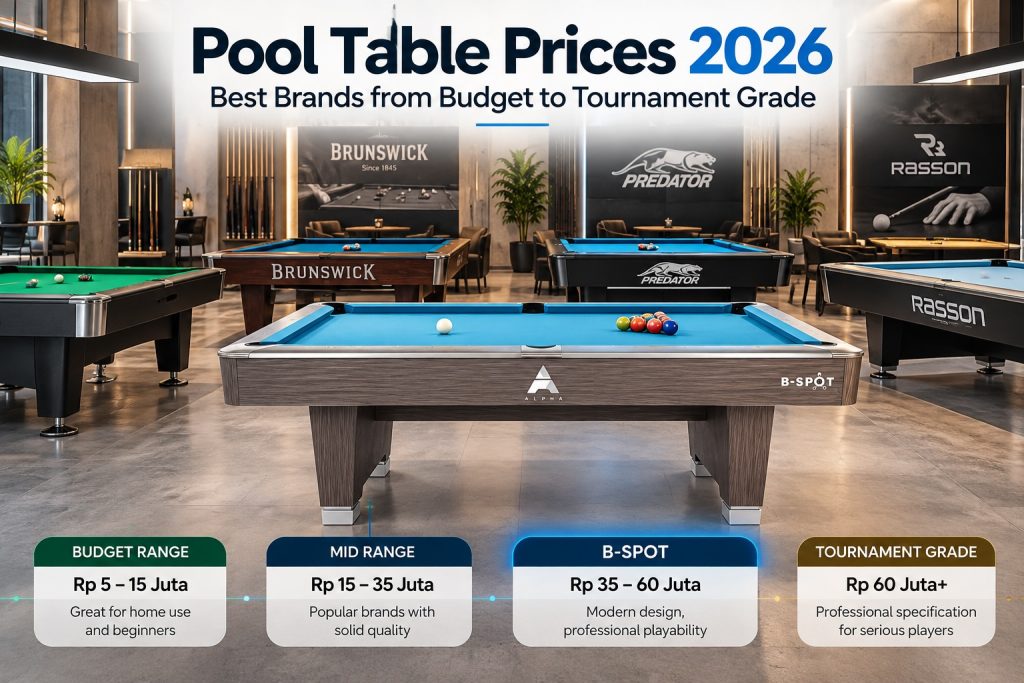
Shopping for a pool table in 2026 can feel confusing. Two tables that look almost identical in photos can sit in completely different price brackets, and listings rarely explain why. The difference usually lies in what you cannot see: the slate, the frame, the cushions and the cloth.
This guide explains the main price tiers, the brands buyers most often compare, how new and used tables differ, and which factors actually drive cost. Instead of quoting figures that change by country, dealer and season, we focus on how to judge value, so you can read any quote with confidence.
Pool Table Price Tiers Explained
The pool table price you pay is best understood in tiers rather than exact numbers. Each tier reflects a different combination of materials, build quality and intended use.
| Tier | Typical construction | Best for | Relative price |
|---|---|---|---|
| Entry / budget | MDF or particle-board bed, light frame, basic cloth | Casual family play, kids, small rooms | Low |
| Mid-range home | One-piece or three-piece slate, solid wood or hardwood-veneer frame, decent cushions | Regular home play, game rooms | Medium |
| Commercial / coin-op | Slate bed, heavy-duty frame, durable cloth, ball return | Bars, cafes, rental venues | Medium to high |
| Premium furniture | Thick slate, solid hardwood, custom finishes | Buyers who want a statement piece | High |
| Tournament grade | Precision-leveled slate, tight tolerances, pro cushions and worsted cloth | Clubs, academies, competitive players | High |
Budget tables
A cheap pool table or cheap billiard table usually replaces slate with MDF or a synthetic bed. That keeps weight and cost down, but the surface can warp over time, especially in humid climates such as Southeast Asia. These tables suit occasional play, not serious practice.
Mid-range tables
This is where most home buyers land. Real slate makes the biggest difference to roll quality, and a solid frame keeps the table level for years. If you plan to play every week, this tier is usually the sensible starting point.
Tournament-grade tables
Tournament tables follow tight specifications. A WPA-spec 9 ft table has a 100 × 50 in (254 × 127 cm) playing surface, a bed height of 29¼–31 in, slate at least 1 in thick, and pocket openings of about 4.5–4.625 in at the corners and 5–5.125 in at the sides. Meeting those tolerances consistently takes better materials and careful manufacturing, which is reflected in the price.
Best Brands to Compare
There is no single best pool table for everyone, but some brands come up again and again when buyers search for the best billiard table in their budget. The list below is a starting point for research, not a ranking.
- Brunswick (USA). One of the oldest names in billiards, known for home tables and the Gold Crown line commonly found in pool halls.
- Diamond (USA). Widely associated with professional-style tables such as its Pro-Am models, popular with serious players and leagues.
- Olhausen (USA). Known for home tables built with solid wood and a wide range of furniture styles.
- Dynamic Billard (Germany). A European maker with home, commercial and tournament models.
- Rasson and Predator. Brands often considered by players looking for modern tournament-style tables.
- Local and regional manufacturers. In markets like Indonesia, local workshops build tables for homes and venues, often at lower cost and with easier service.
How to choose between brands
Brand matters less than specification. Before you buy pool table models from any maker, ask for the slate thickness and number of pieces, the frame material, the cushion rubber type, the cloth composition and the warranty terms. A lesser-known brand with honest specs can be a better buy than a famous name sold without them.
Also check whether the brand has local dealers or technicians. Slate tables need professional installation and occasional re-leveling, and parts such as cushions and cloth eventually need replacing.
New vs Used Tables
Browsing a pool table for sale or billiard table for sale listing, you will see both new and second-hand options. Each has clear pros and cons.
| New | Used | |
|---|---|---|
| Price | Higher | Often much lower for the same build quality |
| Condition | Known, with warranty | Varies; needs inspection |
| Installation | Often included by the dealer | Moving and re-installing a slate table is extra cost |
| Customization | Choose size, cloth color and finish | Limited to what is available |
| Risk | Low | Hidden damage to slate, frame or cushions |
What to check on a used table
- Slate. Look for cracks, chips and whether all slate pieces are present.
- Frame. Check for warping, insect damage and loose joints.
- Cushions. Roll a ball firmly into each rail; dead or uneven bounces mean the rubber may need replacing.
- Cloth. Worn cloth is easy to replace, but factor the cost into your offer.
- Moving costs. Disassembly, transport and professional re-leveling can add a meaningful amount to a “bargain” price.
A good used slate table can outperform a new budget table. Just budget for moving, re-covering and possibly new cushions.
What Drives Pool Table Price
Understanding the cost drivers helps you compare quotes fairly when you buy billiard table models from different sellers.
- Bed material. Slate costs more than MDF but gives a flatter, more stable surface. Thickness and the number of pieces (one or three) also matter.
- Size. A 9 ft table needs more slate, wood and cloth than a 7 ft or 8 ft table, and a larger room.
- Frame and wood. Solid hardwood costs more than veneer or engineered wood, and affects how well the table holds its level.
- Cushions. Quality rubber gives consistent rebounds and lasts longer.
- Cloth. Worsted cloth (typically 80–85% wool, 15–20% nylon) plays faster and more consistently than cheaper woolen blends.
- Pockets and fittings. Leather drop pockets, ball-return systems and decorative castings add cost.
- Delivery and installation. Slate tables are heavy, and professional setup is part of the real price.
- Import and logistics. For buyers outside the manufacturing country, shipping and import duties can change the final billiard table price significantly.
Size and room planning
A practical rule: room size equals the playing area plus two cue lengths on each axis. With a standard cue of about 147 cm, a 9 ft table needs roughly 548 × 421 cm, an 8 ft table about 528 × 411 cm, and a typical 7 ft table about 492 × 393 cm. Shorter cues help in tight spaces, but a cramped room limits how much you will enjoy even the best table.
Common Mistakes When Buying
- Buying on photos alone. Always ask for specifications and, if possible, play on the table first.
- Ignoring total cost. Delivery, installation, accessories and future maintenance all belong in the budget.
- Choosing the wrong size. A table that is too big for the room causes constant frustration.
- Skipping the warranty check. Know what is covered and who services it locally.
FAQ
Is a slate table always better than MDF? For regular play, yes. Slate stays flat and stable, while MDF can warp, especially in humid environments.
What size should I buy for a home? It depends on the room. Measure carefully and use the playing area plus two cue lengths as your guide; many homes fit a 7 ft or 8 ft table better than a 9 ft one.
Is a used table a good idea? It can be excellent value, provided you inspect the slate, frame and cushions and budget for moving and re-leveling.
Do cafes and venues need a commercial table? Commercial tables are built for heavy daily use, so they are usually a better fit than home models for businesses.
Contact B-Spot / Step Asia
B-Spot, operated by Step Asia, works with billiard venues and businesses in Indonesia. Whether you want to supply tables, place them in a venue, or rent them, our team can help you plan.
- Table placement in cafes and venues through the B-Spot partner programme
- Table rental options for businesses and events
- Supply inquiries for venues and resellers
Contact B-Spot / Step Asia for placement, rental or supply inquiries. Get in touch through bspot.app.